

The Pacific, Atlantic, Indian, Southern And Arctic Makeup What Part Of Earth?
The ocean is a huge body of saltwater that covers well-nigh 71 percent of World's surface. The planet has ane global ocean, though oceanographers and the countries of the globe have traditionally divided it into four distinct regions: the Pacific, Atlantic, Indian, and Arctic oceans. Showtime in the 20th century, some oceanographers labeled the seas effectually Antarctica the Southern Ocean, and in 2021 National Geographic officially recognized this fifth body of water. An estimated 97 per centum of the earth's water is found in the ocean. Because of this, the bounding main has considerable affect on weather, temperature, and the food supply of humans and other organisms. Despite its size and impact on the lives of every organism on Earth, the body of water remains a mystery. More eighty percent of the ocean has never been mapped, explored, or even seen past humans. A far greater percentage of the surfaces of the moon and the planet Mars has been mapped and studied than of our ain ocean flooring. Although there is much more to learn, oceanographers have already fabricated some amazing discoveries. For example, we know that the bounding main contains towering mountain ranges and deep canyons, known as trenches, just similar those on state. The elevation of the world's tallest mount—Mount Everest in the Himalaya, measuring 8.84 kilometers (5.49 miles) high—would non fifty-fifty break the surface of the h2o if it was placed in the Pacific Ocean's Mariana Trench or Philippine Trench, two of the deepest parts of the body of water. On the other hand, the Atlantic Ocean is relatively shallow because large parts of its seafloor are made up of continental shelves—parts of the continents that extend far out into the sea. The average depth of the entire body of water is three,720 meters (12,200 feet). It is unknown how many different species call the ocean their domicile. With many marine ecosystems suffering from rising sea temperatures, pollution, and other problems, some oceanographers believe the number of species is dropping. However, there may be many positive surprises awaiting oceanographers in the years ahead. It could be that more than than ninety percent of the ocean's species are still undiscovered, with some scientists estimating that there are anywhere between a few hundred yard and a few meg more to exist discovered. Currently, scientists know of around 226,000 ocean species. Learning more nearly the seafloor and the rest of the ocean is the passion of National Geographic Explorer Marcello Calisti. He is a biorobotics expert who is developing an undersea exploration vehicle that uses "legged locomotion," inspired past the way an octopus moves under h2o. His long-range goal is to design robots that can explore the depths that are difficult for humans to reach. Since the ocean is and then vast, there is plenty for future oceanographers from all corners of the world to explore and discover.
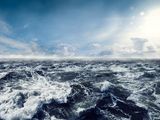
The body of water covers more than seventy percent of Earth, and more than 80 per centum of information technology remains unexplored.
Photograph by Getty Images
biorobotics
Noun
field of robotics that specializes in creating robots that operate like living organisms
Noun
office of a continent that extends underwater to the deep-ocean flooring.
exploration
Noun
written report and investigation of unknown places, concepts, or issues.
marine ecosystem
Noun
customs of living and nonliving things in the ocean.
Noun
large torso of salt h2o that covers nigh of the Earth.
oceanographer
Noun
person who studies the bounding main.
organism
Noun
living or once-living thing.
seafloor
Noun
surface layer of the bottom of the ocean.
species
Noun
group of similar organisms that tin reproduce with each other.
trench
Noun
long, deep low, either natural or man-made.

The Pacific, Atlantic, Indian, Southern And Arctic Makeup What Part Of Earth?,
Source: https://www.nationalgeographic.org/encyclopedia/ocean/
Posted by: gutierrezloseem.blogspot.com
0 Response to "The Pacific, Atlantic, Indian, Southern And Arctic Makeup What Part Of Earth?"
Post a Comment